Waterproof Coatings, Everything you need to know to buy the right product
Waterproof Coatings can prevent disaster if you know the right solution!
Water is one of the most damaging elements that buildings, structures, equipment, and many other surfaces have to deal with. When water enters places where it should not be, it can cause staining, corrosion, mold growth, deterioration of concrete, damage to finishes, and eventually serious structural problems. Waterproofing is therefore an important part of protecting a building and extending the life of its materials.
One of the most widely used approaches to waterproofing is the application of a waterproof coating. Waterproof coatings are protective materials applied to a surface to prevent water from passing through it or to significantly reduce the amount of water that can penetrate the surface. Depending on the product, a coating may also protect against chemicals, ultraviolet radiation, abrasion, temperature changes, and other environmental conditions.
Waterproof coatings are used on roofs, balconies, terraces, basements, foundations, bathrooms, swimming pools, water tanks, concrete structures, metal surfaces, masonry, and many other areas. They are available in a wide range of formulations, including acrylic, polyurethane, epoxy, bituminous, cementitious, silicone, and polymer-modified coatings.
Choosing the right coating, however, is not simply a matter of buying a product labeled "waterproof." Different coatings are designed for different conditions. A coating that works well on a concrete basement wall may not be suitable for a roof that is exposed to intense sunlight and constant temperature changes. Similarly, a product designed for a rigid concrete surface may fail if applied to a surface that moves, cracks, or expands and contracts regularly.
Understanding how waterproof coatings work and how they should be selected and applied is therefore essential.
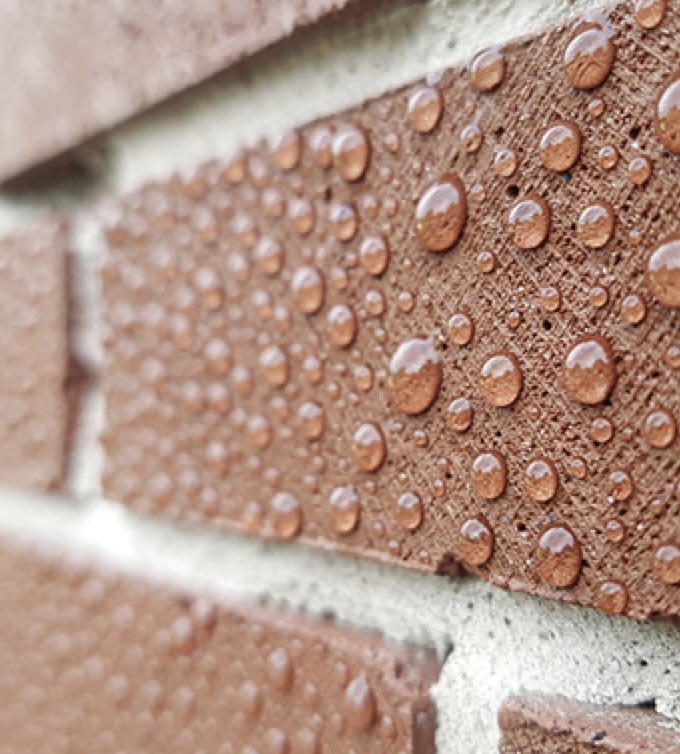
Clay bricks are notorious for being porous, like dense sponges. A quality waterproof coating can seal the brick and extend the life by sealing the water out.
What Are Waterproof Coatings?
A waterproof coating is a liquid, semi-liquid, or sometimes paste-like material that is applied to a surface and then forms a continuous protective layer as it dries or cures.
The resulting layer acts as a barrier between the protected surface and water. Some coatings form a relatively rigid film, while others remain flexible or elastic. The type of film produced is one of the most important characteristics of a waterproof coating.
A coating can prevent water from entering a surface in several ways. It may create a continuous impermeable membrane, fill pores and small surface imperfections, chemically react with the substrate to form a water-resistant layer, or combine several of these mechanisms.
Waterproof coatings are different from simple water-repellent treatments. A water-repellent treatment may cause water to bead on a surface while still allowing water vapor to pass through. A true waterproof coating generally creates a more substantial barrier to liquid water.
The performance of a coating depends on several factors:
- The chemistry of the coating
- The condition of the surface
- Surface preparation
- Application thickness
- Number of coats
- Drying and curing conditions
- Exposure to sunlight and weather
- Movement or cracking of the substrate
- Drainage and water pressure
- Compatibility between the coating and the substrate
A high-quality coating applied incorrectly can perform worse than an ordinary coating that has been properly selected and installed.
Why Waterproof Coatings Are Important
Waterproofing is primarily about preventing damage before it becomes expensive.
Concrete, brick, masonry, wood, metal, and other construction materials can all be affected by prolonged exposure to moisture. Water may enter through cracks, pores, joints, gaps, or poorly sealed penetrations.
Concrete
Concrete is often considered a waterproof material because it appears solid and dense. In reality, concrete contains pores and capillaries through which water can move. Cracks and construction joints can provide even easier pathways.
Repeated exposure to water can contribute to deterioration. In cold climates, water that enters concrete can freeze and expand, potentially causing cracking and surface damage. Water can also transport salts and other substances into the concrete.
Reinforcing steel
In reinforced concrete structures, moisture can contribute to corrosion of steel reinforcement when other necessary conditions are present. As corrosion develops, the steel can expand and place pressure on the surrounding concrete, potentially causing cracking and spalling.
Wood
Wood can absorb moisture. Persistent dampness can lead to swelling, warping, decay, and conditions favorable to fungal growth.
Metal
Water and oxygen can contribute to corrosion of many metals. Waterproof coatings can sometimes provide a protective barrier that reduces exposure to moisture and corrosive environments.
Interior spaces
Water intrusion can damage drywall, paint, flooring, insulation, electrical systems, furniture, and other interior materials. Preventing moisture entry is usually much easier and less expensive than repairing extensive water damage.
Main Types of Waterproof Coatings
Acrylic Waterproof Coatings
Acrylic coatings are water-based or solvent-based coatings made using acrylic polymers. They are commonly used on roofs, exterior walls, concrete surfaces, and other areas where weather resistance and ease of application are important.
Acrylic roof coatings are particularly popular because they can often be applied using a roller, brush, or spray equipment.
One major advantage of acrylic coatings is their resistance to ultraviolet radiation. Many are available in light colors, especially white, which can reflect sunlight and reduce the amount of heat absorbed by a roof.
Acrylic coatings are generally relatively easy to apply and clean up, particularly water-based formulations.
However, acrylic coatings are not ideal for every waterproofing situation. Some products may not perform well under continuous immersion or where there is constant hydrostatic pressure. They can also require careful application to achieve the manufacturer's specified thickness.
Common uses
- Roofs
- Exterior walls
- Concrete surfaces
- Commercial buildings
- Residential buildings
- Previously coated roof systems
Advantages
- Relatively easy application
- Good UV resistance
- Available in reflective colors
- Generally economical
- Many water-based formulations have relatively low odor
Limitations
- Not all acrylic products are suitable for standing water
- Performance depends heavily on proper film thickness
- May have lower chemical resistance than some epoxy or polyurethane systems
- Some formulations have limited flexibility
Polyurethane Waterproof Coatings
Polyurethane coatings are known for their flexibility, durability, and strong adhesion. They are widely used in demanding waterproofing applications.
Polyurethane coatings may be single-component or two-component systems. Some products cure through moisture in the air, while others require mixing of separate components before application.
One of the major benefits of polyurethane is its ability to accommodate movement. Buildings and structures naturally expand, contract, and move slightly due to temperature changes, settlement, vibration, and other forces. A flexible coating can tolerate some of this movement without immediately cracking.
Polyurethane coatings are commonly used on roofs, balconies, terraces, parking structures, concrete surfaces, and other areas where a durable waterproof membrane is needed.
Advantages
- Excellent flexibility
- Good adhesion
- High abrasion resistance in many formulations
- Good weather resistance
- Suitable for many demanding applications
- Can provide a seamless waterproof membrane
Limitations
- Application can be more sensitive to moisture and environmental conditions
- Some products have strong odors during application
- Two-component products require accurate mixing
- Generally more expensive than basic acrylic coatings
- Some polyurethane systems require primers
Polyurethane systems should be selected carefully because different formulations have very different performance characteristics.
Epoxy Coatings
Epoxy coatings are extremely well known for their hardness, adhesion, and chemical resistance. They are frequently used on concrete floors and industrial surfaces.
Waterproof coatings can include many different types of material!
Epoxy coatings can provide excellent protection against water, oils, chemicals, abrasion, and heavy traffic. However, they are generally more rigid than flexible waterproofing membranes.
This distinction is important.
A rigid epoxy coating may perform extremely well on a stable concrete floor but may crack if applied over a substrate that experiences significant movement or cracking.
Epoxy coatings are often used in:
- Warehouses
- Factories
- Garages
- Workshops
- Industrial floors
- Mechanical rooms
- Concrete containment areas
- Commercial facilities
They can also be combined with other systems. For example, an epoxy layer may provide chemical and abrasion resistance while another membrane provides flexibility.
Advantages
- Excellent adhesion to properly prepared surfaces
- High mechanical strength
- Strong chemical resistance
- Good abrasion resistance
- Attractive finish
- Easy to clean
Limitations
- Relatively rigid
- Can crack when the substrate moves
- UV exposure can cause discoloration in some formulations
- Surface preparation is critical
- Mixing ratios must be followed accurately
Epoxy should therefore not automatically be considered the best choice simply because it is strong. Waterproofing requires the right combination of flexibility, adhesion, chemical resistance, and durability for the specific environment.
Bituminous Waterproof Coatings
Bituminous coatings are based on bitumen, a material commonly associated with asphalt and traditional waterproofing systems.
Bituminous coatings have been used for waterproofing for many decades. They are particularly common in below-grade construction, foundations, retaining walls, roofs, and other applications where protection from soil moisture and water is required.
They may be supplied as solvent-based coatings, water-based emulsions, or modified formulations.
Bitumen provides good water resistance and can be relatively economical.
Modified bituminous coatings can include polymers that improve flexibility and durability.
Common applications
- Foundations
- Basement walls
- Retaining walls
- Roofs
- Concrete structures
- Underground structures
- Pipe and tank protection in suitable applications
Advantages
- Proven waterproofing technology
- Good resistance to water
- Generally economical
- Useful for below-grade applications
- Available in many formulations
Limitations
- Some formulations can be sensitive to UV exposure
- Solvent-based products can have strong odors
- May require protection from mechanical damage
- Compatibility with insulation and other materials must be considered
Below-ground bituminous coatings are often protected with drainage boards or other protective layers before backfilling.
Cementitious Waterproof Coatings
Cementitious waterproof coatings are commonly used on concrete and masonry. They generally contain cement-based materials combined with additives or polymers that improve water resistance and adhesion.
They are particularly useful for basements, concrete tanks, water-retaining structures, bathrooms, foundations, and other masonry or concrete surfaces.
Cementitious coatings are often relatively simple to mix and apply. Depending on the product, they may be brushed, rolled, or troweled onto the surface.
One advantage is their compatibility with mineral substrates such as concrete and masonry.
Some cementitious waterproofing systems are designed for positive-side waterproofing, while specialized systems can be used in situations involving water pressure from the opposite side.
Advantages
- Strong compatibility with concrete and masonry
- Useful for below-grade structures
- Relatively simple application
- Many systems are suitable for damp mineral substrates
- Can provide a durable waterproof layer when properly installed
Limitations
- Generally less flexible than polyurethane membranes
- Cracking in the substrate can cause problems
- Surface preparation remains important
- Not every cementitious coating is suitable for movement or active leaks
For structures with significant movement, a flexible membrane system may be more appropriate.
Silicone Waterproof Coatings
Silicone coatings are often used for roofs and exterior applications because of their excellent resistance to weather and ultraviolet radiation.
One of their most important characteristics is their ability to remain flexible over a wide temperature range. Silicone coatings can also perform well in situations involving ponding water, depending on the specific product.
Roofing is one of the most common applications for silicone coatings.
Silicone can be particularly useful when restoring an existing roof system rather than completely replacing it, provided the existing substrate is suitable and properly prepared.
Advantages
- Excellent UV resistance
- Good weather resistance
- High flexibility
- Many formulations tolerate ponding water well
- Useful for roof restoration
Limitations
- Often relatively expensive
- Surface can attract dirt
- Adhesion to some substrates requires specialized preparation or primer
- Repairs and recoating require compatible materials
As with all coatings, the exact product specifications matter more than the generic name "silicone."
Polyurea Coatings
Polyurea is a high-performance coating technology that can cure extremely quickly. It is commonly applied using specialized spray equipment.
Because of its rapid curing and excellent physical properties, polyurea is used in industrial, commercial, transportation, and infrastructure applications.
Polyurea coatings can provide excellent resistance to abrasion, impact, chemicals, and water.
They are particularly useful where rapid return to service is important.
However, polyurea installation generally requires trained professionals and specialized equipment. It is not normally the first choice for a homeowner looking for a simple DIY coating.
Applications
- Industrial facilities
- Parking structures
- Water infrastructure
- Concrete protection
- Secondary containment
- Tanks
- Warehouses
- Transportation structures
Advantages
- Very rapid curing
- Excellent flexibility
- High abrasion resistance
- Good chemical resistance
- Seamless application
Limitations
- Specialized equipment
- Requires experienced applicators
- Higher installation complexity
- Surface preparation remains essential